
We’re proud to spotlight a major milestone for iBeam Materials, an EvoNexus Portfolio Company: a September 14, 2026 feature in Newsweek examining how the company’s manufacturing approach could finally make next-generation MicroLED displays affordable at scale.
The feature, which ran in Newsweek’s Business section, frames a problem the display industry has been circling for years. Today’s OLED screens, including the ones in Apple’s new foldable iPhone, rely on organic carbon-based compounds. As Bruce Berkoff, iBeam Materials’ Chief Marketing Officer, put it to Newsweek, “The O in OLED means organic, so it can die somewhat easily.” Degradation speeds up as brightness climbs.
MicroLED is the widely acknowledged successor. It replaces those organic compounds with millions of tiny inorganic LEDs made from semiconductor materials, producing near-perfect color, contrast, and black levels across televisions, public displays, phones, smartwatches, and smart glasses. What has held it back is not the science but the cost of manufacturing it.
The Manufacturing Bottleneck
Conventional MicroLED production requires manufacturers to move, align, and connect millions of individual components onto a backplane. Even a very low defect rate leaves dead pixels, and finding and repairing those faults adds cost and time. The result is a technology that exists but stays out of reach for most buyers. Samsung’s 146-inch 4K Wall All-in-One, cited in the article, carries a price tag of $219,999.
The research firm Omdia attributes the slow pace of commercialization to high costs, limits in mass-transfer systems, and backplane-yield problems. It still forecasts MicroLED display revenue roughly doubling from $52.4 million in 2025 to $105.4 million in 2026, led initially by near-eye displays, smartwatches, and public screens. Against a global display market estimated at $180 billion to $200 billion a year, the headroom is considerable.
iBeam’s Approach
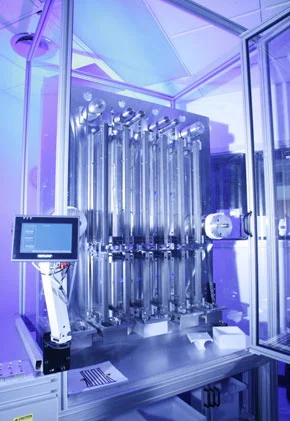
iBeam Materials uses ion-beam-assisted deposition (IBAD) to lay a thin, crystal-aligned surface onto flexible metal foil. Because high-quality semiconductor materials can then be fabricated directly on a continuous roll of that foil, the process has the potential to eliminate the transfer-and-assembly step entirely. The foil travels through manufacturing equipment as layers are added, closer to film moving between reels than to conventional chip assembly, producing a sheet that is later divided into products.
The cost difference is substantial. iBeam estimates that startup capital costs for a roll-to-roll production line could be five to 10 times lower than a current MicroLED line for comparable screen output, with a smaller initial facility cutting that further by a factor of two or three. Berkoff told Newsweek that the path could allow a $100 million investment to stand in for a standard factory costing $2 billion to $3 billion, with operating and material costs potentially 30 to 50 percent lower.
Read the full Newsweek feature →
About iBeam Materials:
A Los Alamos National Laboratory spinout enabling the next generation of high-performance electronics by depositing crystal-aligned thin films on flexible metal foils using proprietary ion-beam-assisted deposition (IBAD) — unlocking GaN microLEDs, power devices, and sensors on substrates that were previously impossible, with a path to low-cost roll-to-roll manufacturing. Learn more here
About EvoNexus:
EvoNexus is California’s leading nonprofit technology startup incubator, with locations in San Diego and Irvine. Since its formation in 2010, EvoNexus has successfully built 290 companies with an exceptional survival rate of over 85%, with portfolio companies securing over $2.4B in cumulative venture funding — backed by a network of more than 400 venture capital and independent investors — and achieving 63 acquisitions alongside a successful IPO, with additional public market exits on the horizon and over $6 billion in pre-exit valuations. Backed by an elite network of global corporate partners — including Irvine Company, Qualcomm, AMD, BAE Systems, Viasat, ResMed, LG, Murata Manufacturing, and EMD Electronics — EvoNexus continues to drive massive economic impact across Southern California’s innovation economy, culminating in a record-breaking year with $619M raised for the portfolio in 2025 alone.